If you want to get a sense of the medical advances made since the Victorian period, I can highly recommend watching The Victorian Pharmacy. I've included all four episodes below.
Episode 1
Episode 2
Episode 3
Episode 4
Sunday, 11 May 2014

Thursday, 30 January 2014
Session 9: Printing and Books
The earliest printed book, a scroll, was made in China in around 860 CE, and was called the Diamond Sutra. (It can be seen in the British Museum). It was printed using 'block printing'.

Block printing involved carving text and pictures in reverse onto a block of wood. The block was coated with ink and then a piece of paper was pressed over it.
Although block printing had been invented, in the early middle ages most books were individually handwritten. One of the main reasons for producing books was to make copies of religious scriptures. In Arab countries, scribes wrote out copies of the Qu'ran, and in Europe monasteries had their own 'Scriptorium', a room where monks copied out and illustrated the Bible. Handwritten books took a long time to produce and were expensive to buy. Although block printing increased the speed of the process, it was still very inefficient. Blocks that had text carved in them could not be reused for a different book.
In the 11th century CE the Chinese invented 'movable type'. With movable type, each letter is carved on a block. The letters are placed in a frame and can be moved around to form different words and sentences. The advantage of movable letter blocks is that they could be used again and again in different combinations.
The tradition of carving wooden movable type is still preserved in some areas of China:


One of the first people reputed to have used modern movable type in Europe was the German, Johannes Gutenberg, in about 1436. Gutenberg invented a wooden printing press, having got the idea from the presses used to crush grapes and make wine.
[If you want to find out more about the printing press, look on Youtube for the hour-long program by Stephen Fry (titled 'the Machine That Made Us') It's been a while since I've watched it, so parental previewing might be appropriate.]
In 1455 Gutenberg produced the first printed Bible in the world. It became became known as the Gutenberg Bible. He printed over 150 copies and it took several years to complete.
William Caxton was the first person to print a book in English, in 1475. He set up a printing shop in London and produced a famous edition of The Canterbury Tales by Geoffrey Chaucer. The text was printed using metal movable letters, known as 'type'.
Arranging type to form words and pages is called 'typesetting'. At first this was done by hand, by compositors. Using movable type meant any errors could be corrected.

(movable type)
Printing wasn't just used to produce books. The first newspapers were printed in Germany and Holland in the 17th century. Hand presses were gradually replaced by steam powered presses in the 19th century, and then by rotary presses.

A quirky little video about letterpress, showing how much work goes into producing a print with an old press.
Today most printing of books is done 'digitally' by computer. There has also been a huge growth in ebooks . These are books that are not printed, but downloaded electronically and then displayed on an electronic device such as a computer or tablet.
If you ever get a chance it's worth visiting the Oxford University Press museum (you will need to book ahead). It has a selection of old printing machines as well as the type used to print 'the long tale' in the book Alice in Wonderland. (if you don't know this part of the book, take a look at page 26 of this PDF ). You can also find old printing presses at The Story Museum in Oxford, where they hold a variety of hand printing workshops.
(the Diamond Sutra)
Block printing involved carving text and pictures in reverse onto a block of wood. The block was coated with ink and then a piece of paper was pressed over it.
Although block printing had been invented, in the early middle ages most books were individually handwritten. One of the main reasons for producing books was to make copies of religious scriptures. In Arab countries, scribes wrote out copies of the Qu'ran, and in Europe monasteries had their own 'Scriptorium', a room where monks copied out and illustrated the Bible. Handwritten books took a long time to produce and were expensive to buy. Although block printing increased the speed of the process, it was still very inefficient. Blocks that had text carved in them could not be reused for a different book.
In the 11th century CE the Chinese invented 'movable type'. With movable type, each letter is carved on a block. The letters are placed in a frame and can be moved around to form different words and sentences. The advantage of movable letter blocks is that they could be used again and again in different combinations.
The tradition of carving wooden movable type is still preserved in some areas of China:
[If you want to find out more about the printing press, look on Youtube for the hour-long program by Stephen Fry (titled 'the Machine That Made Us') It's been a while since I've watched it, so parental previewing might be appropriate.]
In 1455 Gutenberg produced the first printed Bible in the world. It became became known as the Gutenberg Bible. He printed over 150 copies and it took several years to complete.
William Caxton was the first person to print a book in English, in 1475. He set up a printing shop in London and produced a famous edition of The Canterbury Tales by Geoffrey Chaucer. The text was printed using metal movable letters, known as 'type'.
Arranging type to form words and pages is called 'typesetting'. At first this was done by hand, by compositors. Using movable type meant any errors could be corrected.
Printing wasn't just used to produce books. The first newspapers were printed in Germany and Holland in the 17th century. Hand presses were gradually replaced by steam powered presses in the 19th century, and then by rotary presses.
(A steam press from the 1800s)
A quirky little video about letterpress, showing how much work goes into producing a print with an old press.
Today most printing of books is done 'digitally' by computer. There has also been a huge growth in ebooks . These are books that are not printed, but downloaded electronically and then displayed on an electronic device such as a computer or tablet.
If you ever get a chance it's worth visiting the Oxford University Press museum (you will need to book ahead). It has a selection of old printing machines as well as the type used to print 'the long tale' in the book Alice in Wonderland. (if you don't know this part of the book, take a look at page 26 of this PDF ). You can also find old printing presses at The Story Museum in Oxford, where they hold a variety of hand printing workshops.
Wednesday, 22 January 2014
Session 8: Medieval Art - egg tempera paint
The Middle ages/medieval period is well known for its art, and its famous artists who used all sorts of media.
One of the common types of paint used in the Medieval period was tempera. Tempera is paint made of ground up pigment (any natural substance that has a colour) mixed with a binding agent, such as egg yolk.
This way of making paint was known and used in ancient times, but it was particularly common in paintings from the late middle ages. We know this because egg tempera is a long lasting paint and there are many surviving examples.
The colours in egg tempera remain the same over many years, so the egg tempera paintings we can see now are almost as the artist painted them.
The most common way of using egg tempera in Europe was to paint on wooden panels. Egg tempera was used in this way by artists such as Michelangelo and Giotto. Many of the paintings that have survived show religious scenes, but medieval artists painted all sorts of subjects.

How to make egg tempera. We'll be doing something similar in our session - but perhaps a little less perfect!
Giotto is an Italian painter and architect from the late middle ages/renaissance period. He is famed for sending a painting of a perfect circle to the Pope. Why don't you have a try - Use Nicole Collins: Giotto's O: for inspiration.
*For older/less sensitive children* there is an interesting BBC report dated December 2013 at the link below. It describes how medieval wall paintings that had been hidden for years were discovered behind the lime plaster in a church in Wales. Some of the paintings are a little gruesome (my boys would love them!) so parents might want to check out the video first. http://www.bbc.co.uk/news/magazine-25214557
There are a few examples of more modern use of egg tempera paint here
http://www.finearttips.com/2009/12/luminous-egg-tempera-tips-from-a-master/
along with tips on how to use egg tempera.
One of the common types of paint used in the Medieval period was tempera. Tempera is paint made of ground up pigment (any natural substance that has a colour) mixed with a binding agent, such as egg yolk.
This way of making paint was known and used in ancient times, but it was particularly common in paintings from the late middle ages. We know this because egg tempera is a long lasting paint and there are many surviving examples.
The colours in egg tempera remain the same over many years, so the egg tempera paintings we can see now are almost as the artist painted them.
The most common way of using egg tempera in Europe was to paint on wooden panels. Egg tempera was used in this way by artists such as Michelangelo and Giotto. Many of the paintings that have survived show religious scenes, but medieval artists painted all sorts of subjects.
How to make egg tempera. We'll be doing something similar in our session - but perhaps a little less perfect!
Giotto is an Italian painter and architect from the late middle ages/renaissance period. He is famed for sending a painting of a perfect circle to the Pope. Why don't you have a try - Use Nicole Collins: Giotto's O: for inspiration.
*For older/less sensitive children* there is an interesting BBC report dated December 2013 at the link below. It describes how medieval wall paintings that had been hidden for years were discovered behind the lime plaster in a church in Wales. Some of the paintings are a little gruesome (my boys would love them!) so parents might want to check out the video first. http://www.bbc.co.uk/news/magazine-25214557
There are a few examples of more modern use of egg tempera paint here
http://www.finearttips.com/2009/12/luminous-egg-tempera-tips-from-a-master/
along with tips on how to use egg tempera.
Sunday, 5 January 2014
Session 7. Maps and map-making
In this session we'll be looking at maps and map-making.
The very earliest of maps were often pictures or representations of the sky or the 'heavens'. Some were a representation of the known world, but mixed with the mythological or religious beliefs of the time.
The Babylonian World Map is one of the earliest surviving maps

(For more information on possible interpretations of this map, see the Wikipedia entry here
http://en.wikipedia.org/wiki/Babylonian_World_Map )
The foundations for map-making took a huge leap in Ancient Greece. The ancient Greek philosopher, Aristotle (384-322 BCE), is thought to have been the first person to prove the earth is round, and later, another Greek, Eratosthenes, is thought to have come up with a scientific estimate of the circumference of the earth.
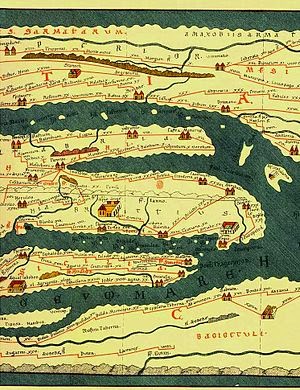
The Tabular Peutingeriana is an early Roman map. It shows the roads of the Roman Empire.

This picture shows one part of the map

The early middle ages used to be called the 'dark ages' because it was believed that there were few advances in science, literature or technology after the fall of the Roman Empire. However, as historians have found out more about this period they realised that this was not such a 'dark' period afterall.
In the early middle ages Islamic scholars built upon the map-making traditions of previous cultures, and also learned from explorers and traders. The Tabulara Rogeriana was a medieval atlas, produced by an Arab geographer (Muhammad al-Idrisi) in 1154. Although the atlas was partly based upon existing maps, it benefited from additional information provided by Arab merchants who had traveled to Africa and the Far East. It is thought to be the most accurate map of the world created in pre-modern times. In this map, North is at the bottom, so it appears upside-down compared to modern maps.

Here is the map, rotated around. Does it look more familiar?

In Europe, medieval maps were mostly symbolic, like those of the Babylonians, and often steeped in religious images and beliefs. The maps, known as Mappa Mundi (cloth of the world), were usually circular or symmetrical and often showed the earth as a central disc surrounded by the oceans. In Majorca, a group of cartographers (map makers) less influenced by these beliefs, produced one of the first known nautical maps - a map with accurate navigational directions)
The later middle ages is known as the Renaissance, but also 'the age of exploration' because of the huge increase in trade and exploration during this period. When the Europeans 'discovered' the Americas and wanted to divide up the lands, map-making once again became popular. This is the first map of The Americas, created by the Spanish explorer and cartographer, Juan de la Cosa, who sailed with Christopher Columbus.

If you're interested in learning more about the history of maps, "The Beauty of Maps" is an excellent BBC series, more suited to older children, which explains the history of cartography. Well worth searching out on YouTube. (I won't post the full episodes here as it's been a while since I've watched them and I can't guarantee age suitability).
This is an excerpt from the first episode on European Medieval Maps, describing the Hereford Mappa Mundi (*warning* if you have a sensitive child the background noise/music can be a bit spooky in places.)
Although the following video is basically an advert for the features of Google Maps, it is a good illustration of modern advances in mapping).
The Ordnance Survey's website for children, Mapzone, has a variety of map-related games. Teaching resources can also be found on the site here.
The very earliest of maps were often pictures or representations of the sky or the 'heavens'. Some were a representation of the known world, but mixed with the mythological or religious beliefs of the time.
The Babylonian World Map is one of the earliest surviving maps

(For more information on possible interpretations of this map, see the Wikipedia entry here
http://en.wikipedia.org/wiki/Babylonian_World_Map )
The foundations for map-making took a huge leap in Ancient Greece. The ancient Greek philosopher, Aristotle (384-322 BCE), is thought to have been the first person to prove the earth is round, and later, another Greek, Eratosthenes, is thought to have come up with a scientific estimate of the circumference of the earth.
The Tabular Peutingeriana is an early Roman map. It shows the roads of the Roman Empire.

This picture shows one part of the map
The early middle ages used to be called the 'dark ages' because it was believed that there were few advances in science, literature or technology after the fall of the Roman Empire. However, as historians have found out more about this period they realised that this was not such a 'dark' period afterall.
In the early middle ages Islamic scholars built upon the map-making traditions of previous cultures, and also learned from explorers and traders. The Tabulara Rogeriana was a medieval atlas, produced by an Arab geographer (Muhammad al-Idrisi) in 1154. Although the atlas was partly based upon existing maps, it benefited from additional information provided by Arab merchants who had traveled to Africa and the Far East. It is thought to be the most accurate map of the world created in pre-modern times. In this map, North is at the bottom, so it appears upside-down compared to modern maps.

Here is the map, rotated around. Does it look more familiar?

In Europe, medieval maps were mostly symbolic, like those of the Babylonians, and often steeped in religious images and beliefs. The maps, known as Mappa Mundi (cloth of the world), were usually circular or symmetrical and often showed the earth as a central disc surrounded by the oceans. In Majorca, a group of cartographers (map makers) less influenced by these beliefs, produced one of the first known nautical maps - a map with accurate navigational directions)
The later middle ages is known as the Renaissance, but also 'the age of exploration' because of the huge increase in trade and exploration during this period. When the Europeans 'discovered' the Americas and wanted to divide up the lands, map-making once again became popular. This is the first map of The Americas, created by the Spanish explorer and cartographer, Juan de la Cosa, who sailed with Christopher Columbus.

If you're interested in learning more about the history of maps, "The Beauty of Maps" is an excellent BBC series, more suited to older children, which explains the history of cartography. Well worth searching out on YouTube. (I won't post the full episodes here as it's been a while since I've watched them and I can't guarantee age suitability).
This is an excerpt from the first episode on European Medieval Maps, describing the Hereford Mappa Mundi (*warning* if you have a sensitive child the background noise/music can be a bit spooky in places.)
Although the following video is basically an advert for the features of Google Maps, it is a good illustration of modern advances in mapping).
The Ordnance Survey's website for children, Mapzone, has a variety of map-related games. Teaching resources can also be found on the site here.
Monday, 9 December 2013
Session 6: Money
In our last session this term we'll be looking at money.
A brief history of money
Coin production in ancient Greece
A short video on how banknotes are made. (This also serves as a good guide of how *not* to make a video! :) )
You might find it useful to check out The Royal Mint Museum's website here for some short children's videos on how coins are made and distributed. The website also has other coin-related resources.
Tuesday, 26 November 2013
Session 5: The Abacus
Abacus is a Latin word that means 'sand tray' or 'sand board'. The abacus is a very ancient counting tool, possibly in use in Mesopotamia as long ago as 2000 BCE, and later in ancient Egypt, Persia and Greece. In its early form it was most likely a simple counting board or tray with a series of stones in grooves.
The ancient Greek abacus was a table or tablet with counters set into it. The earliest tablet found has been dated to around 300 BCE. The Romans adopted a similar abacus to the ancient Greeks, but later developed an abacus that used beads threaded on wires. This had the advantage of being much quicker to use.
The earliest evidence of the use of the abacus in China dates from around the 1st century CE. The Chinese abacus is known as a Suanpan. The Japanese adopted a similar design, called the Soroban.
In the workshop we are going to make a 5 + 2 abacus. This is an abacus where there are two beads above the dividing bar and 5 below it. This is the easier type of abacus to learn to use. The following 3 videos show basic operations on a 5 + 2 abacus.
This video demonstrates the use of the 4 + 1 abacus, which is slightly harder to learn because it involves complementary numbers. (There is also a good explanation here http://abacus.etherwork.net/pages.htm but it gets rather complicated as you go down the page!)
In Japan soroban training is taken very seriously and there are national competitions involving huge calculations. With practice calculations on an abacus can be faster than using a calculator. This video shows the sort of calculations that can be done.
Wednesday, 13 November 2013
Session 4: The Archimedes screw
A screw is basically a slope or inclined plane wrapped around a cylinder in a spiral shape. You can think of it as being like a road up a mountain. If you wanted to drive up a mountain, you would find the mountain too steep to drive in a straight line from the bottom to the top. But if you took a longer, less steep route, spiralling around the mountain and gradually working your way up to the top it would be a lot easier.
Archimedes' screw is a machine, based on a screw design, that is used to move liquids. It was named after the famous ancient Greek mathematician, inventor and engineer, Archimedes of Syraceuse.
Although the machine took his name, Archimedes may not have been the original inventor. It is likely that a similar design had been in use for some years before Archimedes wrote about it. Whether Archimedes was the influence or not there is evidence that the screw design was used in Ancient Egypt to pump water from the Nile to irrigate crops in fields. There are also suggestions that the design may have originated in Assyria, (an area that would now include parts of Turkey, Iraq, Iran and Syria). It is quite possible that several ancient cultures arrived at the same design independently.
Archimedes screw is primarily designed for moving liquids. The design was later developed into the "screw conveyor" which moves dry materials (powders, pellets,grains etc)using the pushing action of its rotating blades. This LEGO model is probably the best illustration of how the screw conveyor works and how it could be used in industry.
The screw design can also be used 'in reverse'. Instead of using power to turn the screw in order to carry liquids upwards, a liquid poured into the top of a screw can turn the screw and produce energy. The video below demonstrates how using a large screw and a flowing water source can generate electricity. (It's an unnecessarily long video (!), but the first minute or so will give you a good overview of how it works).
Archimedes' screw is a machine, based on a screw design, that is used to move liquids. It was named after the famous ancient Greek mathematician, inventor and engineer, Archimedes of Syraceuse.
Although the machine took his name, Archimedes may not have been the original inventor. It is likely that a similar design had been in use for some years before Archimedes wrote about it. Whether Archimedes was the influence or not there is evidence that the screw design was used in Ancient Egypt to pump water from the Nile to irrigate crops in fields. There are also suggestions that the design may have originated in Assyria, (an area that would now include parts of Turkey, Iraq, Iran and Syria). It is quite possible that several ancient cultures arrived at the same design independently.
Archimedes' screw traditionally consists of spiralling blades inside a hollow cylinder or tray. As the screw is turned the liquid is trapped in the spaces left by the inclined blades and gradually moves up the cylinder.
This demonstration below shows the basic principle (using plastic tubing on the outside of a cylinder). The video below it shows an enormous Archimedes screw in action.
Here is an entertaining use for an archimedes screw design!
The spiral/screw shape can be seen in nature too. This video shows how a long shell could be used in the same manner as an archimedes screw.
Archimedes screw is primarily designed for moving liquids. The design was later developed into the "screw conveyor" which moves dry materials (powders, pellets,grains etc)using the pushing action of its rotating blades. This LEGO model is probably the best illustration of how the screw conveyor works and how it could be used in industry.
The screw design can also be used 'in reverse'. Instead of using power to turn the screw in order to carry liquids upwards, a liquid poured into the top of a screw can turn the screw and produce energy. The video below demonstrates how using a large screw and a flowing water source can generate electricity. (It's an unnecessarily long video (!), but the first minute or so will give you a good overview of how it works).
Tuesday, 5 November 2013
Session 3: Gunpowder and Fireworks
Probably the best overview of the subject is the video from the Royal Institution lectures below
Watch the full video with related content here: http://richannel.org/the-science-of-fireworks
Watch the full video with related content here: http://richannel.org/the-science-of-fireworks
Tuesday, 8 October 2013
Session 2: Windmills and wind turbines
The windmill is thought to have been invented in ancient Greece. The first record of a wind-driven wheel is from the 1st century CE by the Greek mathematician and engineer, Heron (or Hero) of Alexandria. He invented a wind-driven wheel to power a musical organ.

More practical windmills - i.e. those used to grind grain or draw up water - were invented in Persia in the 9th century CE. They had sails that spun around horizontally.
In Europe the earliest recorded windmills (in the 12th century) had sails that spun in a vertical plane. The sails were made of a framework with sailcloth stretched over it. If the wind speed changed the miller would need to stop the mill and alter the coverage of the sailcloth. By the 19th century sails had been designed to have slats and they could automatically adjust to the wind speed.


Most windmills have four sails, but those with more sails were built, both in Britain and, earlier, in areas of Spain, Portugal and Greece.
The inside of a windmill contains gears. As the sails move the axis they are fixed upon moves the 'brake wheel'. This has teeth that drives a horizontal gearwheel and transfers the power to the mill stones. There are often other gear wheels that help to hoist sacks or drive other machinery.


The basic design of the windmill has not only been used to grind grain, but also to power papermills, threshing mills and wind-driven water pumps.
More recently, windmills have led to the design of wind turbines which generate electricity and provide a possible alternative energy source to fossil fuels.
Wednesday, 11 September 2013
Session 1: Catapults
The word catapult comes from the Greek words for 'downwards' and 'to toss or to hurl'.
Catapults are thought to have been invented by the ancient Greeks around 300-400 BCE. Early designs were basic arrow-firing mechanisms, similar to hand-held crossbows. As they developed they became larger and more complicated with winched pull-back systems and torsion springs.
The main use of catapults was on the battlefield. Alexander the Great was among the first Greeks recorded as having used catapults in battle. As the use of catapults became increasingly common, even Greek children were taught how to use them.
The Romans also used catapults in war. Their early machines were very similar to large crossbows.
In the medieval period catapults were used as 'siege weapons'. These catapults were large. Many were on wheels so they could be moved around and positioned to hit a target. They were used to breach the walls of castles and cities.
There were various designs of catapult during the medieval period, including the mangonel. The mangonel was used to throw heavy objects - or sometimes unpleasant items such as animal dung - from a cup-shaped holder on the end of its arm. (The model we are making in our session is similar in design to a mangonel.)
The trebuchet is also another well-known medieval weapon using a catapult design.
Reconstruction of a medieval trebuchet at Warwick Castle, England:
Catapults have been used in war right up until the early 20th century. At the beginning of World War I soldiers used catapults to fire hand grenades from the trenches.
Nowadays catapults are less likely to be used in war and more likely to be used in recreational activities.
For an introduction to the physics of catapults real world physics problems is quite a good site.
Subscribe to:
Posts (Atom)